¶ Elliptic Curve Cryptography: Enhancing Security with Mathematical Elegance
As we delve deeper into the cryptographic landscape, building on our understanding of basic cryptographic principles and the universal language of mathematics, Elliptic Curve Cryptography (ECC) emerges as a pivotal advancement. ECC not only offers a more efficient alternative to traditional public key cryptography systems but also embodies the intricate relationship between mathematical theory and cryptographic application.
¶ From Basic DH Key Exchanges to ECC
Recall the basic Diffie-Hellman (DH) key exchange, a foundational method for secure key exchange over an insecure channel, relying on the discrete logarithm problem for its security.
We touched on this before, showing how one-way functions using remainders require “brute-forcing” to work backwards from the remainder to the original inputs.
Even though standard Diffie-Hellman still works well, and runs in standard systems all over the world, another in cryptography is further increasing our asymmetric advantage: elliptic curves.
¶ Example of a Finite Field Operation
We’ve been hovering around an important concept just so far: finite fields.
A finite field, also known as a Galois field, is a mathematical system where a finite number of elements can undergo operations such as addition, subtraction, multiplication, and division (except by zero), with results that are also within the same set.
You can imagine how a video game might have a fixed-size playing field, so when you move your character over one edge, it appears on the other side. Thhe field might be finite but the moves the character can make are infinite.
For a simple example, consider a finite field of 10 elements (0 through 9).
In this field, when you add 5 and 7, the operation “wraps around” due to the finite nature of the field. Since the direct sum (12) exceeds the field’s maximum element (9), we take the remainder when dividing by the field’s size (10) to find the result within the field:
[ 5 + 7 = 12 \equiv 2 \mod 10 ]
Thus, in this finite field of 10 elements, adding 5 and 7 yields 2, illustrating how operations within finite fields are constrained to ensure that all results remain within the set. This property, called Closure, is crucial for the arithmetic operations involved in cryptographic algorithms, for both security and computational efficiency.
Notice something about it? The modulus is used here each time any operation pushes beyond the boundaries of the finite field.
While the set of possible values (or positions, in the analogy) is finite (ensuring that the numbers involved do not grow too large to handle), the operations that can be performed (or moves that can be made) are, in a sense, infinite in variety. This allows for a rich set of possibilities within a controlled, secure framework, making it hard to guess, or brute-force the calculations in reverse.
¶ Enter Elliptic Curves
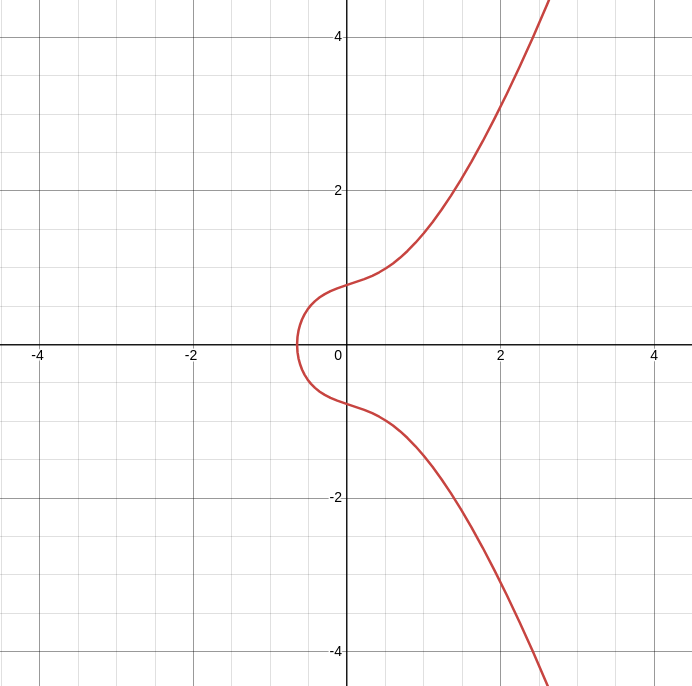
Geometrically, an elliptic curve is a set of points that satisfy a specific cubic equation in two variables, typically written in the form y^2 = x^3 + ax + b , where 4a^3 + 27b^2 ≠ 0 (to avoid singularities). This equation produces a smooth, non-intersecting curve that is symmetrical about the x-axis. When plotted, it reveals a distinctive shape with a single loop. In the context of ECC, these curves are considered over finite fields, meaning that the values of x and y are limited to a finite set of numbers, and the operations on the curve adhere to the arithmetic rules of that field.
¶ Closure on Elliptic Curves
The property of closure in the context of elliptic curves over finite fields means that for any two points P and Q on the curve, the point R resulting from P+Q is also on the curve. Similarly, the result of scalar multiplication (repeated addition of a point to itself) will also be a point on the curve. This closure property is crucial because it ensures that all cryptographic operations are predictable and confined within the set of points on the curve, making the system secure and manageable.
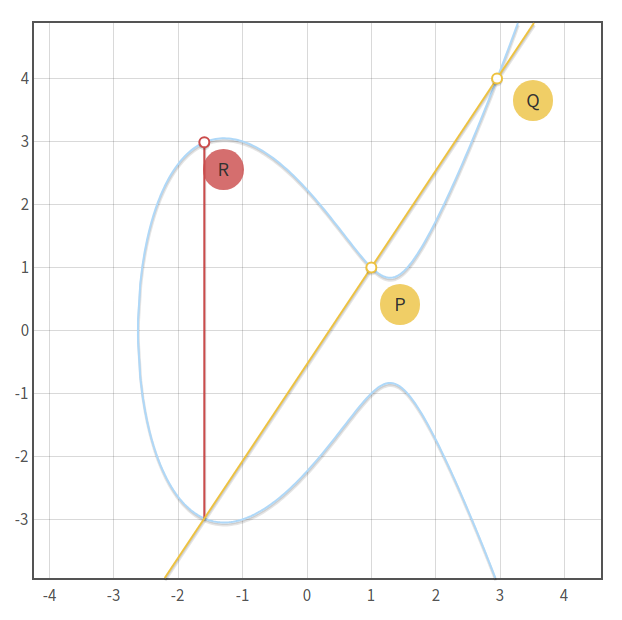
Closure on the elliptic curve means choosing any two points on the curve (P and Q) will create a line that always intersects the curve somewhere else ®. You can play with this graph here.
Elliptic Curve Discrete Logarithm Problem (ECDLP) is harder to solve than the discrete logarithm problem or the factoring problem in integer fields we saw earlier, allowing for shorter keys to achieve equivalent security levels.
¶ Predictable Properties of Elliptic Curves
Elliptic curves possess properties ideal for cryptography:
- Closure: The sum of any two points on the curve remains on the curve.
- Associativity: Point addition is associative, facilitating complex cryptographic operations.
- Existence of an Identity Element: There’s a point that acts as an additive identity, akin to zero in regular arithmetic.
- Existence of Inverse Elements: Every point on the curve has an inverse, ensuring every operation is reversible in theory, but not easily so, which is essential for security.
DH exchanges utilizing ECC (ECDH) leverage the properties of elliptic curves over finite fields, offering equivalent security with significantly smaller keys. This efficiency stems from the Elliptic Curve Discrete Logarithm Problem (ECDLP), a harder problem that allows for shorter keys and faster computations without compromising security. Effectively, smaller keys with the same security means greater asymmetrical advantage.
¶ Understanding the ECDLP
Let’s see how the ECDLP becomes exponentially harder on elliptic curves.
Consider the operation (P + Q = R) on an elliptic curve, where (P), (Q), and (R) are points on the curve. While adding points is straightforward, deducing (P) or (Q) from (R) is computationally infeasible, providing a robust asymmetric advantage.
Example with Math:
Given points (P) and (Q) on an elliptic curve, their sum (R) can be calculated using the curve’s equation, say (y^2 = x^3 + ax + b). However, trying to reverse this operation to find (P) or (Q) given (R) is akin to solving the ECDLP, a task so difficult it secures ECC against attacks.
If you’d like to go deeper, Andread Corbellini made a great tutorial.
¶ Euler’s Identity and the powers of logarithms
Euler’s Identity, (e^{i\pi} + 1 = 0), stands as a testament to the profound interconnectedness of mathematics, weaving together the fundamental constants of our universe into a tapestry of elegant simplicity. At the heart of this identity lies Euler’s Number, (e), a constant that emerges from the depths of logarithmic functions, the very same functions that underpin the discrete logarithm problem pivotal to elliptic curve cryptography (ECC). This connection is not merely coincidental but a reflection of the underlying mathematical symphony that orchestrates everything from the orbits of planets to the security of our digital communications.
In exploring the realms of ECC, we encounter the concept of cyclic groups, where operations loop back on themselves in a finite setting, much like the hands of a clock resetting after reaching the twelfth hour. This cyclical nature, where every action leads back to a starting point, mirrors the cyclic patterns found throughout the natural world, from the seasons to the life cycles of stars. It’s here, in the cyclic groups of ECC, that we see the shadows of Euler’s insights into the cyclical patterns of numbers, where raising (e) to the power of (i\pi) brings us back to the starting point of -1, a journey through the complex plane that returns us to the familiar.
The beauty of ECC, and indeed all of cryptography, lies not just in its ability to secure our digital lives but in its connection to the fundamental principles that govern the universe. Through the lens of ECC, we see not just equations and algorithms but a reflection of the universe’s inherent order and symmetry. The discrete logarithm problem, with its roots in logarithmic functions and cyclic groups, serves as a bridge between the abstract world of mathematics and the tangible reality of our daily lives, reminding us that the same principles that guide the stars also protect our most private communications. In this way, ECC and Euler’s Identity invite us to marvel at the elegance of the universe, a place where mathematics, physics, and cryptography dance together in intricate harmony.
¶ Conclusion
Elliptic Curve Cryptography stands as a testament to the power of mathematical principles applied to cryptographic security. By leveraging the complex, yet predictable properties of elliptic curves within finite fields, ECC achieves a level of security and efficiency that traditional systems cannot match with equivalent key sizes. This advancement not only underscores the relevance of mathematical innovation in enhancing digital security but also highlights the ongoing dialogue between the finite and the infinite, between the elegance of mathematical theory and the practical exigencies of cryptographic application.