The concept of public goods is foundational to our understanding of shared resources and collective benefit. These goods are characterized by their non-rivalrous and non-excludable nature, meaning their consumption by one individual does not reduce availability to others, and no one can be effectively excluded from their use. Distinguishing between public goods and public services is crucial; the former is inherently accessible to all, while the latter may require payment or membership.
Classic examples of public goods include clean air, national defense, and public parks. The Web itself is a public good.
Education is an interesting example. A university class is not a public good, because there are a limited number of seats. Using up one seat is “rivalrous” because it takes up a spot someone else wants, leading to rivalry in allocating seats. An recorded course on the internet, made available for free, is a public good, because unlimited people can take the course without excluding others.
Why use economic language to describe such things? Because our current social and economic systems lead us to treating them as “externalities” when they’re used to serve a profit-motive. Recognising this, when we seek to preserve them collectively, we financialise them. viewing clean air as carbon credits, peace as war-economics, and parks as real estate.
¶ The Funding Conundrum of Public Goods
The open-source software movement presents a modern dilemma in funding public goods.
The reality is that most of the Internet, and almost all computing devices, run on open source software, a public good. It’s creators were significantly motivated by its capability in enabling things to become public goods, to “free” journalism, to “open” education.
In an of itself, this isn’t an issue, but with the contrast of closed commerical models always able to draw on public goods in such a way, they create a resource pull, effectively a funding conundrum. How do we sustainable fund public goods in such a world?
If you dissected a Macbook or Android phone’s software, or any major web platform, you’d find most of it is open source, was written by people who were never paid. These commercial behemoths are propped up by altruists and hobbyist programmers, most of whom would do a lot more if they could be properly paid for their work.
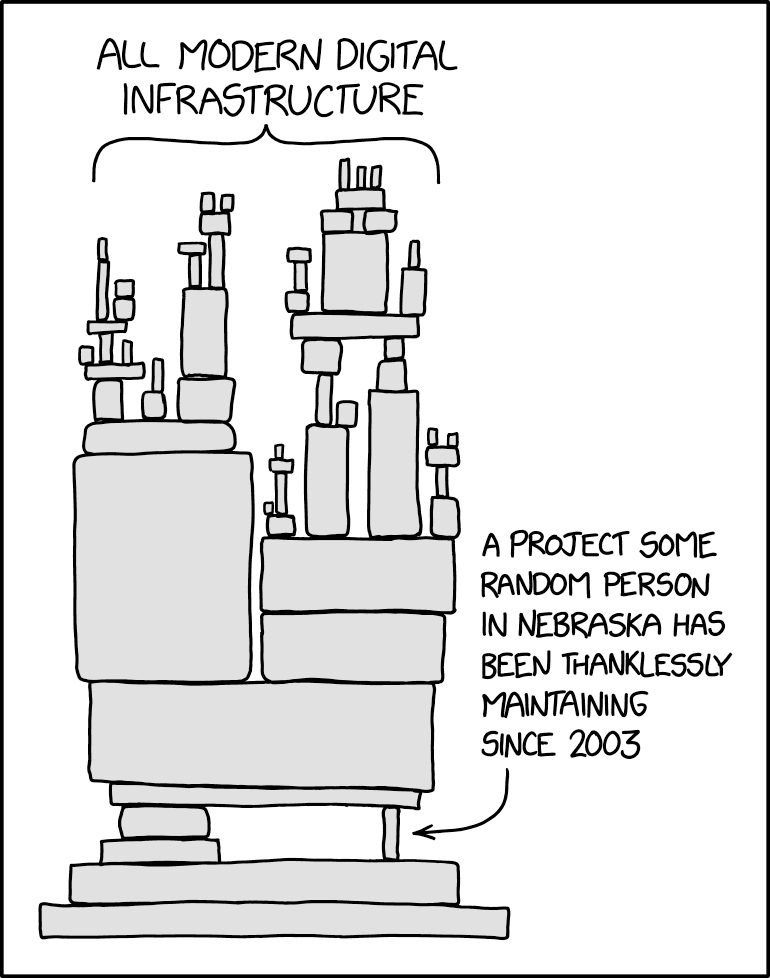
Traditionally, outside of direct sponsorship (make a donation) developers have explored models like open-core and paid-support. Open Core is where the foundational software is free and open-source, but key features are closed and monetized. Apple’s OS, for example is built on top of an open source and Linux-like operating system called BSD. That’s the open core, and Apple built a closed, proprietary front-end for it. Paid-support is where the software is free, but users pay for maintenance and support. Redhat and many enterprise software companies use this model. While innovative, these models don’t support large categories of public goods well, leaving the builders of the open cores and libraries unpaid, and pushing end-user oriented software towards closed, commercial models. They introduce elements of rivalry and exclusion, compromising the public good nature of software and platforms.
Drawing parallels to Setha Low’s work on public spaces, we observe a similar trajectory of privatization in open-source projects. What begins as a public interest initiative can gradually become privatized through policing, surveillance, investment, and rezoning, leading to a form of digital gentrification that sidelines the original beneficiaries.
¶ Immutable Open Source: A New Paradigm
The advent of immutably deployed software on blockchain platforms offers a groundbreaking solution. By leveraging blockchain technology, open-source projects can achieve both revenue generation and protection from privatizing forces, ensuring their status as true public goods.
¶ Hyperstructures: Redefining Public Goods
Hyperstructures represent a novel framework within the blockchain ecosystem, characterized by their:
- Unstoppability: They run indefinitely without maintenance or interruption.
- Free Access: They operate at zero protocol-wide fees, ensuring non-excludability.
- Value Accrual: They can generate and distribute value among participants.
- Expansiveness: Built-in incentives encourage participation and growth.
- Permissionlessness: Universal access and censorship resistance are guaranteed.
- Credible Neutrality: They offer fair, unbiased interaction mechanisms.
Platforms like Zora, Maker, and Yearn exemplify hyperstructures. Their fundamental functions are coded immuibly into smart contracts, which collect fees and redistrubute them permissionlessly. Look closely at them, the smart contracts themselves are hyperstructures, and how the organisations around them respond to them. (Contrast this with software companies or projects, where the code bases respond to the shareholders and management.)
These platforms embody the principles of hyperstructures by creating positive-sum environments that thrive on open participation and innovation, rather than trying to constantly capture and monetise it. And yet, they provide a way to fund public goods makers.
¶ Reflections on the Future of Public Goods
The emergence of hyperstructures challenges us to reconsider the nature of public goods in the digital age. They offer a blueprint for creating resources that are truly non-rivalrous and non-excludable, protected from the forces of privatization and accessible to all.
- How can traditional open-source projects leverage the hyperstructure model to preserve their public good status?
- What ethical considerations arise in the creation of immutable, unstoppable public goods?
- How do hyperstructures navigate the balance between innovation and the risk of rigidity inherent in their immutable nature?
As we delve deeper into the potential of hyperstructures, we stand on the brink of a new era for public goods. By embracing the principles of blockchain technology, we can envision a future where shared resources remain truly public, fostering innovation, inclusivity, and collective benefit.
¶ Questions to Consider
- What are the key performance metrics that would define success for your hyperstructure? Would it be TVL (total value locked), growth rate of new users, or something else?
- How will you ensure that the governance model remains effective as the community grows? How will you protect against political centralisation, and antagonistic fund extraction?
- What contingency plans do you have in place for potential vulnerabilities or unforeseen challenges?
- What genuine need or problem does the hyperstructure aim to solve, ensuring it provides a unique, non-rivalrous, and non-excludable solution?
- How can a strong core team of developers, strategists, and community managers with diverse, complementary skills be built for the hyperstructure?
- What strategies can be employed to enhance community engagement and turn early adopters into evangelists for the hyperstructure?
- Which governance model should be chosen to balance inclusivity and efficiency, allowing for community input while making timely decisions?
- What built-in incentives can be integrated to reward participation and align with the hyperstructure’s long-term goals?
- How can the technical robustness, security, and scalability of the hyperstructure’s underlying code be ensured, given its immutable nature?
- What legal and ethical considerations, including compliance with regulations and potential misuse, need to be proactively addressed?
- Which funding and sustainability options are most viable for the initial development of the hyperstructure?
- How can iterative development be implemented to evolve the ecosystem around the hyperstructure, incorporating regular updates and new features?
The path to creating a successful hyperstructure is fraught with challenges and uncertainties, but the rewards—both for the individual and the community at large—are immense. As you ponder these questions and embark on your journey, remember that the most transformative innovations often come from asking the right questions and daring to venture into the unknown.